Dandelion Wind Swirl Art
As a designer who’s stitched over 300 custom embroidery projects—from boutique baby onesies to limited-run apparel for Etsy sellers—I opened Dandelion Wind Swirl Art expecting lightness. What I found was more than pretty: it’s a quietly confident design that breathes like real wind, not just a flat swirl of petals and seeds. I tested it on a linen-cotton tea towel for a local kitchen goods shop, then scaled it down for a newborn onesie—and both times, the mood held. That’s rare.
First Impressions: Airy, Not Fragile
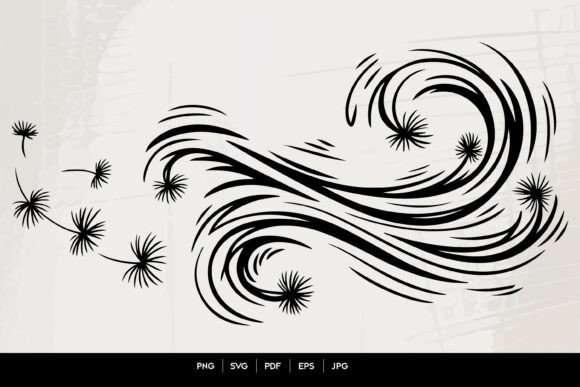
The moment you view the PNG or SVG file, you sense motion—not frantic, but gentle. The dandelion head dissolves into delicate seed parachutes that spiral outward with subtle asymmetry. There’s no rigid symmetry or forced geometry; instead, there’s botanical rhythm. It feels spring-soft but summer-strong—ideal for products where customers want quiet elegance, not loud graphics. This isn’t a “look at me” motif. It’s a “breathe with me” one.
For embroidery designers, that translates directly: low visual noise, intentional negative space, and organic flow. That means fewer stitch conflicts in tight corners, smoother satin-stitch transitions on curved elements (like seed stems), and natural breathing room between fill-stitch zones. No overcrowding. No visual fatigue—even at 4-inch hoop size.
Where It Shines: Real Projects, Real Customers
I used Dandelion Wind Swirl Art as the centerpiece on a heavyweight organic cotton tote for a botanical apothecary client. Stitched in soft ecru thread on oat-colored fabric, it read instantly as handmade—not digital, not mass-produced. Customers paused at the booth. One asked, “Did you draw that yourself?” That’s the gold standard: when your embroidery design feels like a signature, not a stock asset.
It also worked beautifully as a single-embroidery patch on unbleached denim caps—no backing peek-through, no distortion on the curve. Because the swirl opens toward the front brim, the motion reads forward, not sideways. That small directional intelligence matters for apparel decorators.
For baby embroidery? I resized it to 2.2 inches wide on a bamboo-blend onesie. The seed details stayed legible without becoming fussy. Parents appreciated the nature theme without cliché—no bunnies, no rainbows, just quiet growth and release. Perfect for gender-neutral nursery decor or milestone blankets.
Etsy sellers will find this especially versatile for printable mockups and digital product previews. The clean vector (SVG/EPS) scales crisply for social thumbnails, while the high-res JPG and PDF hold up in listing banners. As a Graphics asset, it bridges digital and physical seamlessly.
Where to Pause—and Why
This isn’t a one-size-fits-all embroidery file. Its airy quality becomes a liability on certain substrates:
- Thin or sheer fabrics: The open swirl can read as “missing” rather than intentional if stabilizer shows through. Use tear-away + cut-away combo on lightweight rayon or voile.
- Stretchy knits: The spiral shape pulls differently across grain lines. Hoop with adhesive stabilizer and test stitch density—too many fill stitches in the center head can cause puckering.
- Dark or textured fabrics: Those fine seed outlines vanish on black terry cloth or bouclé. Opt for metallic or tonal thread (e.g., silver on charcoal) or simplify the outermost seeds in your editing software before digitizing.
- Curved surfaces under 3 inches: Caps and beanies compress swirls. Test the smallest viable size first—below 1.8 inches, some seed trails lose definition.
Also: avoid pairing Dandelion Wind Swirl Art with dense text or heavy borders. Its strength is subtlety. Slap a bold font next to it, and the whole composition feels unbalanced—not curated.
Design Integrity Meets Commercial Sense
For craft business owners and small shop product developers, this design earns trust because it doesn’t over-promise. It won’t dominate a sweatshirt like a logo—but it will elevate a minimalist hoodie into something thoughtful and ownable. That builds brand consistency over time, especially for shops rooted in nature, mindfulness, or slow living.
Customer engagement rises when embroidery feels intentional—not decorative filler. A customer buying a dandelion-embroidered pillow cover isn’t just buying decor; they’re buying resonance. And Dandelion Wind Swirl Art delivers that without needing explanation.
Practical Designer Notes Before You Stitch
- Test on scrap fabric first—especially if using on textured or dark backgrounds.
- Check thread color contrast in natural light, not just screen preview. Ecru, oat, and heather gray often outperform stark white.
- Review stitch density manually: the dandelion head should be denser than the trailing seeds, but not so dense it balloons on knit fabric.
- Confirm hoop size compatibility—this design flows best in 4×4 or larger hoops. Avoid forcing it into a 3×3 unless you’re willing to simplify seed count.
- Inspect small details at actual stitch size: those tiny seed stems must clear your machine’s minimum stitch length (usually 0.5mm).
- Test in black-and-white mockups. If it loses its wind-like flow in grayscale, adjust contrast or simplify outer loops.
- Use proper stabilizer: medium-weight cut-away for stable wovens, adhesive + tear-away for knits.
- Verify licensing terms before selling finished items or bundling as part of a digital embroidery kit. Since this is listed as a Graphics asset for Crafts, confirm commercial use rights directly with the creator.
In short: Dandelion Wind Swirl Art isn’t flashy—but it’s faithful. Faithful to botanical truth, faithful to embroidery’s tactile language, and faithful to the quiet confidence your customers respond to when they hold something truly handmade. Use it where stillness speaks louder than noise. That’s where it lives best.