Honey Bee Doodle Clipart Set
First Impressions: Whimsy That Stitches Well
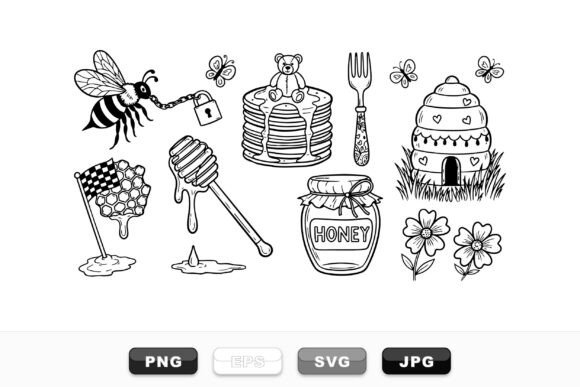
Opening the Honey Bee Doodle Clipart Set feels like flipping through a sketchbook left on a sunlit kitchen counter—loose, warm, and full of quiet personality. These aren’t stiff clipart icons; they’re hand-drawn vector line art elements with intentional wobble, gentle tapering lines, and breathing room between shapes. I immediately tested one element—the bee carrying a padlock—on a mockup of a linen tea towel. It landed softly, not shouty. That’s key: this set leans into charm over precision, making it ideal for handmade products where authenticity matters more than pixel-perfect symmetry.
A Real Project Check: Embroidering a Custom Baby Apron
Last week, I used three elements from the Honey Bee Doodle Clipart Set—a beehive, a single butterfly, and the honey jar—to create a custom embroidered baby apron for a boutique nursery line. The apron was 100% cotton twill, medium weight, stabilized with tear-away + light cutaway. Here’s what stood out: the line weight held up beautifully at 3.5" wide, the curves stitched cleanly without puckering, and the open negative space in the honey jar silhouette let the fabric show through—giving the finished product lightness and breathability. Customers responded to that subtle texture; one emailed saying, “It looks like someone drew it just for my little one.” That’s the Honey Bee Doodle Clipart Set doing its quiet work.
Where This Set Shines (and Where It Asks for Care)
The Honey Bee Doodle Clipart Set excels in projects where storytelling and softness matter:
- Personalized gifts: A tote bag with the dripping dipper + flowers reads as joyful, not cutesy—perfect for a baker’s birthday or new mom’s kitchen kit.
- Boutique branding: The decorative fork and pancakes-topped-with-teddy-bear combo adds warmth to café aprons or bakery packaging without feeling generic.
- Nursery decor: Butterflies and flowers scale down well for crib mobiles or pillow covers—just avoid the teddy-pancake element below 2.75" wide; the tiny bear’s details risk stitching into mud.
- Holiday embroidery: Paired with simple script lettering (“Honey & Heart”), the beehive becomes a gentle Valentine’s or Mother’s Day motif—no glitter, no fuss, just sincerity.
But here’s the honest part: this set isn’t built for every surface. On stretchy fabrics like ribbed knit sweatshirts, the fine lines in the bee’s wings can blur unless you use a firm stabilizer and reduce stitch density manually. On dark fabric, test thread colors first—the thin outlines need high-contrast thread (e.g., bright yellow on navy) to retain legibility after washing. And skip curved surfaces like caps unless you simplify the layout: the honey jar’s drips and the padlock’s tiny links don’t translate cleanly across a dome.
Design Integrity Meets Commercial Reality
As an embroidery designer who ships 50+ custom orders monthly, I judge clipart sets not by how many elements they include—but by how often I reach for them *without second-guessing*. The Honey Bee Doodle Clipart Set earns repeat use because its visual language is cohesive: same line weight, shared rhythm, consistent whimsy. That cohesion builds brand consistency—whether you’re an Etsy seller listing embroidered tea towels or a small shop owner creating seasonal kitchen bundles. Customers notice when motifs feel intentional, not assembled. And yes, it lifts perceived value: a $24 linen pillow cover with the beehive + two flowers reads as thoughtfully designed, not mass-produced.
That said, it won’t replace technical applique designs or dense fill-stitch motifs. There’s no satin stitch border built in, no layered shadow effect—this is pure line art. So if your workflow relies on auto-digitized fills, plan time to add those yourself. Or better yet: embrace the simplicity. Let the line stand alone. That’s where the handmade presentation shines.
Practical Notes Every Embroiderer Should Run Through
Before cutting thread or uploading to your machine, do these six things:
- Test on scrap fabric—same type, same stabilizer, same hoop size you’ll use for the real project.
- Check thread color contrast on both light and dark backgrounds using a printable mockup. What reads as charming on white may vanish on charcoal.
- Review stitch density manually if your software allows. Thin lines can over-stitch; reduce density by 10–15% for smoother flow.
- Inspect small details under magnification: the padlock’s clasp, the teddy bear’s ears, the fork’s tines. If they’re smaller than 1.2mm wide in your final size, consider simplifying or omitting.
- Confirm licensing before selling finished products or digital embroidery files. Since this is a Graphics collection for Crafts, verify whether commercial use is included—or if attribution is required.
- Use proper stabilizer—especially for textured fabrics like burlap or terry cloth. The delicate lines need support, not suppression.
Final Thought: Not Just Clipart—A Design Partner
The Honey Bee Doodle Clipart Set doesn’t scream. It hums. It fits quietly into baby embroidery, kitchen textiles, and heartfelt gifts—not as decoration, but as punctuation. When your customer runs their fingers over a sweatshirt stitched with the honey jar and a single flower, they’re not just touching thread. They’re sensing care, intention, and the kind of detail only hand-drawn line art delivers. That’s why I keep this set in my active folder—not as filler, but as a trusted voice in my design vocabulary.